Do More vs Do Less

Remember the good old college days when doing more was the norm. I am not talking about just more work – I am talking about doing more number of things. Half a dozen courses in a semester, multiple projects, assignments, sororities, fraternities, science club, that extra research work, volunteering for the local school – all this in addition to working part-time jobs to make ends meet. At any point of time, there were a dozen things that you had on your mind.

And it made sense. There was so much to learn and do. The only possible way was to do more. Some of it was mandated for you (by the college rules), the other a result of your passion and eagerness to learn. You wanted to get your hands in many pies. You liked to brag about all the stuff that you were juggling and doing well.

The same continued as you started your first job (even worse if you started up your own shop). Although work was more streamlined, specially if you joined a larger organization, but still as a newbie you wanted to do tidbits of everything from doing your work to helping others to volunteering to peeking to see how others do their jobs. Doing so much – and so diverse of it – made you feel cool. Your learning was on fast track.

And still it all made sense. After all, life still has a heap to offer and you just did not know enough. The only way to fill that gap was to do lots of things.

This do more approach worked well – until it stopped working anymore!
Continue reading

Pomodoro is not just a tomato …

Earlier I wrote that an effective way to manage our time is using the model of long walks. The core idea was that we just do not need time free of distractions but we also need it long enough to be effective on a particular task. Smaller chunks of time here and there can never be as effective as a single contiguous block of time.

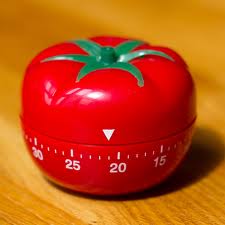
ImageA technique to achieve this is ‘Pomodoro’. Pomodoro is the Italian word for tomato but the name of the technique is motivated by a kitchen timer.

What Pomodoro suggests is to work in chunks of 30 minutes. Every 30 minute ‘Pomodoro’ is divided into 25 minutes of actual work and 5 minutes to reflect and reenergize. The key is that in each of such 30 minutes, you should just work on a ‘single’ task. All distractions and deviations should be eliminated.

For example, if I am writing this article, I can dedicate 30 minutes to come up with the first draft. I make sure that I do not check email, attend a phone call or wander in my thoughts to the upcoming vacations. I need to laser-focus on the task I defined before I started.

Continue reading

My Weekly GTD Review

Earlier I argued why GTD is valuable for knowledge workers and what my GTD system is. Here is how I do my Weekly Review – a critical piece of the GTD system.

All processes in life run forward. Good processes also have intermediary checkpoints where progress is analyzed and adjustments are made. (e.g. A Scrum project team does retrospectives at the end of every work iteration – where the good, the bad and the potential pitfalls ahead are reviewed and course corrected).

Weekly Review is just that. It is an explicit weekly checkpoint in our GTD life where we deliberately stop doing the regular stuff, rise up from the life’s battlefield, take a stock of all the stuff around us, analyze the previous week and look ahead the next. We adjust, tweak and re-prioritize and take away or add stuff in our lives. It’s an ‘inspect and adapt’ activity – and is immensely powerful.

As important as the review, is the fact that it is weekly. A week is the optimal work and planning unit. Give someone two weeks for a task and it will be most likely addressed in the second week. Hence, most planning and reporting is done on a weekly basis.

My Weekly Reviews are on Friday afternoons. It’s scheduled for 30 minutes on my calendar. Friday is a good time with work traffic slowing down and I have better visibility into the weekend and next week.

Continue reading

How I manage my GTD Stuff

Last time I talked about GTD and why it helps a knowledge worker. Today, I’ll describe how I personally manage the GTD system – the tools, habits and the quirks.

Disclaimer: How I manage is what works for me. It may not be the same for you. The intent is to give you example of an implementation. The process is more important than the content. Had there been a one-size-fits-all implementation, GTD probably would have prescribed it.  

I use electronic tools and external (cloud) storage of data (tasks, emails, documents etc.) for efficient access. My system has the following pieces:

– My Capture Lists
– Calendars
Evernote

Continue reading

Why I use GTD?

Once asked for his telephone number, Einstein looked it up in the directory. He replied to the curious requester that why should he waste his brain in storing something when he can easily retrieve it when required. 

This is the essence of Getting Things Done (GTD) methodology – which I and million others use to organize our lives.

GTD is not a productivity tool. It is a methodology to manage stuff entering in our lives and how we manage it.  

Most of what we call organizing consists of creating to-do lists and reminders. We are typically creating these artifacts with no process to manage and use them. The result is often “we forgot”, “it fell through the cracks” or “I never got around to doing it”. There is stress, inefficiency and lost opportunities.  

Our brain is for processing, not storing stuff. We cannot depend on our memory to generate reminders or organize large information. At best, we can hold a few items in our brain at anytime. Enter a new input and an existing item may drop off. Our psyche cannot be our system.  

Continue reading

Dare you work from home!

Yahoo! recently banned work from home. The news made splashes and attracted backlash.

Image

To me, it looks more an effort to rectify the inefficiencies in Yahoo organization that have creeped up over the years than a productivity statement. It looks remedial and reactive. If so, the Yahoo-wide ban on working from home is an overkill. It is doctoring the symptoms rather than addressing the cause. If not, and it is actually the company’s vision of how Yahoo engineers should work, the move may backfire.

I am not a big proponent of work from home. You won’t find me canvassing for it on campaign trail. Work from home is a privilege not a right. Organizations are social structures to make people work together to achieve its goals. Getting together under one roof certainly looks the most efficient way to get people to work together. Kids go to school – they don’t “study from home”. Hospitals need patients to come over – they don’t “heal from home”. Passengers don’t “fly from home”, lawyers don’t “argue from home” and prisoners don’t “serve their term from home”.

So what’s the problem?

Continue reading

Are reading books of no value any more?

Is there any value in reading books now that you can find everything online? 

That’s a question that has polarized the knowledge world for a while. One group predicts the end of books now that all information is available on the internet. The other group detests the prediction arguing that books are eternal. 

ImageLets clarify the problem first. As in such debates, the core question gets so muddy that no one really knows what they are really arguing about. When we say books, its the old-fashioned hard-binded version that focuses on a single subject at length. That is what we are comparing with the astronomical quantity of information in internet addressing every possible subject. 

Another clarification: when we say books, a physical version is equivalent to a soft copy like on Kindle. That is simply a question of different media addressing reading convenience and efficiency. The structure and nature remain the same. A book on Kindle stays a book. 

Continue reading

Your workspace is your friend!

LinkedIn recently shared a fabulous photo series titled “Where I work” featuring workspaces and work habits of what it calls “thought leaders” – essentially all knowledge workers. Each of the 50+ places were described by their occupants. It was just awesome to see them and the amount of thought and insight that went into their design and customization.

Image

The LinkedIn article was a pleasant complement to my current re-reading of “Peopleware” – one of the all-time classics for management of knowledge workers. The book dedicates one of its complete sections to “The Office Environment” and how it is one of the key components of effective work (and the most abused and ignored one as well). 

Going through the picture series, I could not help extract common themes and patterns even from a widely eclectic and diverse collection of people and businesses. Not surprisingly, many resonate with the ideas in Peopleware. One cannot emphasize the importance of a personalized, open and comfortable workspace and the impact it has on one’s work. 

Here are the common themes I found (you are welcome to add to them):

Continue reading

Is process a bad thing?

The world seems to be divided into two groups. One which loves process and the other which detests it.

ImageA process streamlines, automates and standardizes a task such that doing it does not take more thinking than required nor leaves room for deviation. We create a process to automate and simplify the repetitive and make it efficient. We tend to avoid reinventing the wheel every time. We follow a process to file our taxes, claim our expenses, apply for a vacation, register our new car and communicate with our customers. A process is created to help simplify our lives and save us time. It is intended to bring order and control to our lives. 

So what is the problem? Why does the second group exist at all? What is their argument? 

Continue reading

Long Walks

I like long walks, especially when they are taken by people who annoy me.
— Noel Coward

Sir Coward was known for his wit. But there is some germ of truth in every humor and this quote is no exception. It is always good to have some time and space to one self.

We tend to get more done when we have uninterrupted time to ourself. Good ideas come in lonely long walks. We solve problems in morning shower. We take a long drive on our favorite country road to clear our mind. Even, a brilliant idea or solution is there as we wake up after a good long sleep!

All this is true. We generally do our best when abetted by solitude and a conducive environment. But these observations do not have to sound as mythical as they do. They are actually grounded in the basic principles of productivity and time management.

There are two common attributes in all these scenarios – the long walks, the picturesque drives, the morning showers and the uninterrupted sleep – that help explain why they are effective for our productivity and creativity.

Continue reading