Dare you work from home!

Yahoo! recently banned work from home. The news made splashes and attracted backlash.

Image

To me, it looks more an effort to rectify the inefficiencies in Yahoo organization that have creeped up over the years than a productivity statement. It looks remedial and reactive. If so, the Yahoo-wide ban on working from home is an overkill. It is doctoring the symptoms rather than addressing the cause. If not, and it is actually the company’s vision of how Yahoo engineers should work, the move may backfire.

I am not a big proponent of work from home. You won’t find me canvassing for it on campaign trail. Work from home is a privilege not a right. Organizations are social structures to make people work together to achieve its goals. Getting together under one roof certainly looks the most efficient way to get people to work together. Kids go to school – they don’t “study from home”. Hospitals need patients to come over – they don’t “heal from home”. Passengers don’t “fly from home”, lawyers don’t “argue from home” and prisoners don’t “serve their term from home”.

So what’s the problem?

Continue reading

Are reading books of no value any more?

Is there any value in reading books now that you can find everything online? 

That’s a question that has polarized the knowledge world for a while. One group predicts the end of books now that all information is available on the internet. The other group detests the prediction arguing that books are eternal. 

ImageLets clarify the problem first. As in such debates, the core question gets so muddy that no one really knows what they are really arguing about. When we say books, its the old-fashioned hard-binded version that focuses on a single subject at length. That is what we are comparing with the astronomical quantity of information in internet addressing every possible subject. 

Another clarification: when we say books, a physical version is equivalent to a soft copy like on Kindle. That is simply a question of different media addressing reading convenience and efficiency. The structure and nature remain the same. A book on Kindle stays a book. 

Continue reading

Your workspace is your friend!

LinkedIn recently shared a fabulous photo series titled “Where I work” featuring workspaces and work habits of what it calls “thought leaders” – essentially all knowledge workers. Each of the 50+ places were described by their occupants. It was just awesome to see them and the amount of thought and insight that went into their design and customization.

Image

The LinkedIn article was a pleasant complement to my current re-reading of “Peopleware” – one of the all-time classics for management of knowledge workers. The book dedicates one of its complete sections to “The Office Environment” and how it is one of the key components of effective work (and the most abused and ignored one as well). 

Going through the picture series, I could not help extract common themes and patterns even from a widely eclectic and diverse collection of people and businesses. Not surprisingly, many resonate with the ideas in Peopleware. One cannot emphasize the importance of a personalized, open and comfortable workspace and the impact it has on one’s work. 

Here are the common themes I found (you are welcome to add to them):

Continue reading

Is process a bad thing?

The world seems to be divided into two groups. One which loves process and the other which detests it.

ImageA process streamlines, automates and standardizes a task such that doing it does not take more thinking than required nor leaves room for deviation. We create a process to automate and simplify the repetitive and make it efficient. We tend to avoid reinventing the wheel every time. We follow a process to file our taxes, claim our expenses, apply for a vacation, register our new car and communicate with our customers. A process is created to help simplify our lives and save us time. It is intended to bring order and control to our lives. 

So what is the problem? Why does the second group exist at all? What is their argument? 

Continue reading

A Joke is a very serious thing …

Sometimes in life you have to confess what you have been doing in the past. I have been guilty of being a “Quotes Collector over the years. (My best defense: So is David Allen of GTD fame!)

Also at a certain time in your life, you start mapping everything you see and experience into your own world. So I went through my collection, shortlisted 40 humorous quotes and mapped into the world of Knowledge Workers and their managers!

Don’t laugh at me. As Charles Churchill said in his writings “A joke’s a very serious thing”.

Here you go ….

1 – The severity of the itch is inversely proportional to our ability to reach it.
             — Jill Shalvis
There will be things you will not have control over in the organization. They’ll itch. Accept it!

2 – You may never learn to swear until you learn to drive.
            — Steven Wright
You never grow up as a professional unless you have lived through a bad project or a bad boss. 

3 – He is one of those people who would be enormously improved by death.
            — Saki
If you have “one of those”, get rid of them

Continue reading

Long Walks

I like long walks, especially when they are taken by people who annoy me.
— Noel Coward

Sir Coward was known for his wit. But there is some germ of truth in every humor and this quote is no exception. It is always good to have some time and space to one self.

We tend to get more done when we have uninterrupted time to ourself. Good ideas come in lonely long walks. We solve problems in morning shower. We take a long drive on our favorite country road to clear our mind. Even, a brilliant idea or solution is there as we wake up after a good long sleep!

All this is true. We generally do our best when abetted by solitude and a conducive environment. But these observations do not have to sound as mythical as they do. They are actually grounded in the basic principles of productivity and time management.

There are two common attributes in all these scenarios – the long walks, the picturesque drives, the morning showers and the uninterrupted sleep – that help explain why they are effective for our productivity and creativity.

Continue reading

Parkinson’s Law to our Advantage

The United States Congress averted a major tax hike and expenditure cut – the so-called “fiscal cliff” – by reaching a compromise deal just before the deadline of January 1, 2013. “Just before” practically was the start of January 1.

It was a tough milestone considering there was a divided Congress and political polarization on economic issues. However, the deadline was known for ever, practically built into the system and the backdoor negotiations for the compromise deal were in full swing for many weeks. Yet, the deal was reached at the eleventh hour – only when the hard deadline was at the door. Interestingly, there have been similar eleventh hour deals on fiscal deadlines over the last few years.

parkinsonThis is an example of Parkinson’s law in real life – famously known as Work Expands to Fill the Time Available. Everyone involved kept on negotiating and trying to get their way in the deal until they could do that no more. Usually, we expand the work required to achieve some goal based on how much time we have. We adjust our focus and plans accordingly. We define the complexity and scope of the task if we can based on how much time we have.

There are many other real-life examples. Cricket matches finish in the last over. Projects end at the last minute. All news in the world magically fits into the same 16 pages of a newspaper. Meetings consume all their allotted time. We reach office just in the nick of time. Deals are reached at the last minute. Storage requirements increase to fill the storage capacity. Our expenses adjust to fit our income.  Given any deadline or constraint, we carve an execution path in such a way that we finish right at the end. Not before, not after.

There are two very interesting corollaries for Parkinson’s Law.

Continue reading

Lessons from “The Avengers”

A form of mental torture not appreciated enough is kids forcing moms and dads to watch their favorite shows over and over again. Barbie, Dora, Diego, Tom & Jerry, Ben 10, Cinderella, Superman, Spiderman – you name it. In my case, its my 6 year old and The Avengers. I have even lost the view count. And I don’t even really like it.

But repetition is effective. Redundancy works. Forced slavery leaves its marks. It lets you view things differently and abstractly. Once I resigned myself to my misery, I tried to eek something out of it.

ImageAvengers is a team of superheros brought together to save the world from evil and annihilation. Each had some extraordinary skill – good enough to have a brand of their own. Iron Man, Captain America, Hulk, Thor, Black Widow. Avengers, name of their team, battle against the evil of Thor’s brother Loki to save the world. Here are my three lessons from my incarceration:

Continue reading

The ‘Boring’ Sampras

Nothing is perfect. That is why pencils have erasers, software has Undo and Tennis now has the Player Challenge System.

ImageHowever, there are many things which are near-perfect. For example Pete Sampras as a tennis player. Sampras was considered a winning machine, stayed world number one for six consecutive years, won 14 grand slams and achieved everything that a tennis player can dream of. Heck, he even beat Roger Federer, the then world number one, in an exhibition match 5 years after he retired. He had every shot in the book, excelled on all surfaces and practically won every tournament worth winning.

But Sampras was also considered by some as ‘boring’ and ‘mechanical’. For most of his career, he played so well that his wins seemed even effortless at times. He won tournaments without much fanfare or “heart in the mouth” moments. His general expressionless demeanor while slaying his opponents with textbook shots made him look mechanistic at times. There was no fuss about his game.  The flamboyant Andre Agassi called him “more robotic than a parrot” and went on to say “I envy Pete’s dullness. I wish I could emulate his spectacular lack of inspiration, and his peculiar lack of need for inspiration”. Even Sampras’s autobiography read mechanistic (compared to that of Agassi which actually contained these comments).

Continue reading

The Creative Stretch

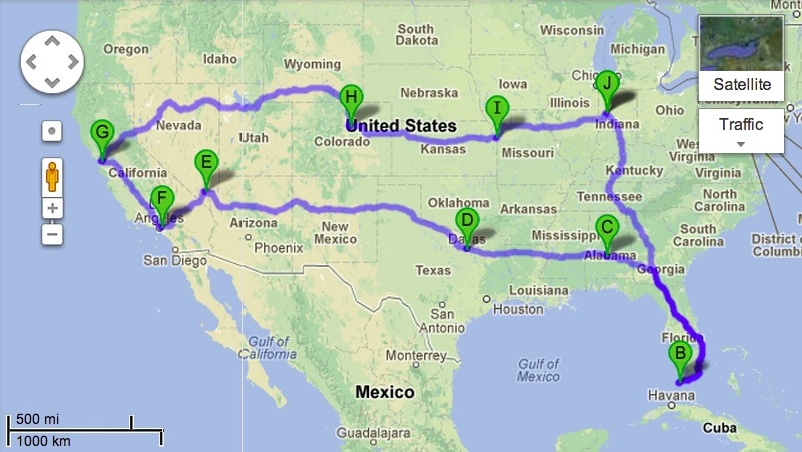
If you are driving to the grocery store couple of miles away from your home, your planning for the trip will be minimal compared to planning a cross-country road trip. For grocery store, a cursory look at the fuel gauge may suffice. For the road trip, if you have enough resources, you need extensive planning. Money, maintenance, weather and time all become considerations. The very notion of a destination far away forces you to think and plan differently – encouraging and even forcing to be creative.

Image

Our road trip 2003

Think of a startup. It is typically cash-strapped. One way forward is to grow organically. You depend on the revenues you generate. You build slowly while keeping the lights on. All investments are conservative and cautious. As you keep the liabilities to a minimum, you also limit the flexibility and freedom of action. You first ensure cash flow to sustain the monthly expenses before you think of hiring or availing that training opportunity.

The alternate path is to get external financing – say from a venture capitalist. You give up some of your equity in the company and have more stakeholders to answer to. But you also get this doze of welcome cash that lets you not worry about the next payroll or rent payment. Money is not a variable anymore at-least in the short term.  You have more space to be creative and think and plan big. With enough resources, you can plan a road trip rather than just be confined to visit to your local grocery store. You are encouraged – even forced – to be creative and think big. You can actually accomplish much bigger things.

Continue reading